More luxury
Festival THEATER DER WELT – Ortsbegegnungen
"I think that one of the most urgent questions that we ought to address with regard to festivals is how — in the face of social and economic complicities — we can appropriate festivals as a space of critical undertakings, […] a space for new solutions: in particular, for ones that seem inconceivable today."
Marta Keil2
In a constantly changing society, internationally oriented theatre festivals act as both a source of inspiration and a sounding board. They combine (political) engagement within a globalised art world with a sense of belonging to a local community.3 The concept of internationality, the world and global working that they pursue or generate in this context is just as interesting as the reconnection to the respective urban and regional environment in which the festival operates.
Since 1979, the festival – initially known as Theatre of Nations and, since 1981, as Theatre of the World – has been organised by the German Centre of the International Theatre Institute (ITI) in different cities. For the ITI, as the organiser of THEATER DER WELT, the focus has been not only on the immediate impact at the respective host city from the very beginning, but also on the indirect transferability, resilience and sustainability of this festival format. Whenever the festival is awarded to a new city, the question arises: how can a process of constant local reinvention – theatre-making in the extreme – relate to questions of the festival’s rooted long-term presence and its enduring legacy?
The following text examines the THEATER DER WELT festival from three perspectives: building on an analysis of the festival’s formative phase during the transition from Theatre of Nations to THEATER DER WELT and an explanation of the festival’s fundamental characteristics, the text focuses on the impact of festivals as venues for (temporary) activity and as driving forces behind urban regeneration.
From Theatre of Nations to Theater der Welt
Theatre of Nations
Theatre festivals are always political. Even the earliest theatre festivals in Europe (including the Festival d’Avignon and the Edinburgh International Festival), founded in the 1940s, were part of the social and cultural renewal processes of the post-war era, which were intended to provide structural support for a ‘Never Again’. ‘Theatre of Nations’ (TNF) should also be seen in this context. This festival was founded by the International Theatre Institute (ITI) – the world’s largest organisation for the performing arts.4
Shortly after the ITI was founded, the international federation decided at its 2nd Congress in Zurich in 1949 that an international festival under its auspices was needed. 5 Following a proposal by A.M. Julien, then director of the Théâtre Sarah Bernhardt, and by resolution of the International ITI at its 5th Congress in Dubrovnik in 1955, the festival was held for the first time in 1957 under the name Theatre of Nations.
The festival was then held annually, initially at the Théâtre Sarah Bernhardt and, until 1972, at the Théâtre Odéon in Paris. As the largest international theatre festival at the time, it was an integral part of the international festival scene.6
The objectives and strategies of the ITI Worldwide and its respective national centres shaped the work and direction of the festival. They were a recurring topic of discussion at congresses, conferences and in training programmes. It was the forms of cooperation between Eastern and Western centres that kept diplomatic communication (and festival invitations) open during the Cold War, but also the links with centres in the Global South that made TNF appear, in the 1960s, to be the most international of the international festivals.7
Following an ITI resolution, this structure was reformed in the 1970s and an application process was introduced, enabling the festival to tour the world; its first international edition, held in Warsaw in 1975, already signalled a non-Western approach to theatre.
In 1979, the festival was held in Hamburg at the invitation of the German ITI. Ivan Nagel, then World President of the ITI, served as both artistic director and curator. Together with programme director Thomas Petz, he devised a programme that, alongside major productions from state theatres, also gave space to independent theatre, thereby responding to the global restructuring of the theatre world. The festival was a hit with audiences.8 This is what Nagel says about the development of THEATER DER WELT:
On the second weekend of the festival, a smart official from the Bonn Ministry of the Interior approached me to ask whether the German Centre of the International Theatre Institute might be willing to continue the festival. The federal government would, on a trial basis, cover a third of the costs. I agreed, without authorisation from the board or the association.9
It almost seems as though this is a myth that Nagel is presenting. Surprisingly, there are very few written sources on the founding process of THEATER DER WELT that could verify or refute this account.

THEATER DER WELT
In the early 1980s, international festival curation was not yet the norm.10 Mistrust towards the state and the struggle against institutional rigidity shaped the restructuring of ‘Theater der Welt’ for the German cultural sphere. Thus, the fundamental structural principles that Nagel sets out for THEATER DER WELT can be summarised, almost dogmatically, in the following negations: no state or other influence on the artistic direction, no ‘representation’ of continents, no dominance of state theatres, no adherence to state guidelines, no educational event, no motto.11
The transition from Theatre of Nations to THEATER DER WELT was therefore not simply a scaled-down version of the original. Whilst ‘Theatre of Nations’ sought to showcase what was representative of each country, Nagel maximised the curatorial role in THEATER DER WELT.12 And there is another aspect that seems particularly interesting from a geographical perspective. Theater of Nations was usually produced for the capitals of the host countries. The fact that THEATER DER WELT, by contrast, was conceived as a travelling festival through the still relatively young Federal Republic of Germany seems, even if there was a pragmatic financial rationale13, to have been much more of a political decision in response to the provisional capital status of Bonn.14 This established a fundamental core of the festival. The festival took place at varying intervals, always in a different German city and under new curatorship.15 Each city had to be developed and discovered anew as a festival city, particularly in the early years, involving not only local and regional cultural policy but also the wider urban community. One of the key objectives of this structure, which Nagel described in his festival dogma, was made possible in the first place by this constant renewal: the discovery of ‘yet unknown, potential theatre spaces’. Linking the staging of the festival closely with the discovery and development of new theatre venues was only possible through this constant renewal. It remains to be explored how a process of constant local reinvention – a form of theatre-making taken to extremes – relates to questions of the festival’s rootedness in the long term and its enduring nature.
Ruins performed16
Processes of urban development
Theatre festivals, by their very nature, possess a porosity that enables them to extend beyond the artistic realm into the public urban space and to transform it.17 Owing to their unique character, they hold the potential to drive architectural and institutional developments on a scale that would often be inconceivable in the day-to-day realm of urban and cultural policy, as they urgently require new venues and new architectural discoveries for their realisation. Particularly in the 1980s and early 1990s, one can often observe shared driving forces between the emerging international touring theatres and international theatre festivals, which in some cases referenced one another in their programmes and where the guest theatres were often integrated into the festival’s organisation (as they were often better suited to experimental formats than traditional theatres).18 The resulting indirect contributions to sustainability were not always intended as such by the festival organisers. Nevertheless, these contributions cannot be denied. As an example, some of these reciprocal contributions at THEATER DER WELT are presented here.
The Bockenheimer Depot, a former tram depot, played a key role in staging the 1985 festival in Frankfurt am Main. Thomas Petz and Thomas Kremer, programme director and head of organisation respectively, took on the task of finding a suitable venue for Peter Brook’s monumental production of ‘Mahabharata’ and, after some initial difficulties, were able to secure the depot, which had just been vacated by the Light Railway Museum.19 Following THEATER DER WELT, the depot was repeatedly made available for cultural events. The fire at the Frankfurt Opera House in 1987 then led to the conversion and development of a permanent venue within the depot.
In 1993, Renate Klett managed to incorporate the Muffathalle – a former steam power station that had just been converted into a cultural venue – as a venue for THEATER DER WELT in Munich.20 With a spectacular programme – including productions such as Brace Up! and Fish Story by The Wooster Group – this venue became a must-visit during the festival and thus established itself on Munich’s theatrical and cultural map.21
As early as 1994, when THEATER DER WELT in Dresden had just been nominated, discussions were already taking place regarding the Hellerau Cultural Centre – whose restoration as a cultural venue had been the focus of a supporters' association since the early 1990s – as to how it could possibly be offered as a performance venue to international theatre professionals given the disastrous state it was in.22 The political leadership in Dresden at the time did not view Hellerau as a key element of its urban development strategy and tended to rely on private investment in this regard. Nevertheless, a group of architects and artists worked tirelessly to influence the development of Hellerau and repeatedly raised funds.23 Hellerau became a key player in the festival under Hannah Hurtzig – particularly with the audio-visual installation Les jours ordinaires by Kristian Boltanski and Jean Kalman, which artistically explores Hellerau’s heritage and sought to contribute to the reappropriation of this artistic venue.24
In 2002, the Forum Freies Theater (FFT) in Düsseldorf was a key partner in the festival organised under Lilienthal, which in turn helped to stabilise the theatre under Niels Ewerbeck.25 As part of the urban-focused project City Mapping – Living with the City, the FFT commissioned artists to engage with the city of Düsseldorf. Lilienthal emphasised the sustainability of this approach – supporting the local independent theatre scene was, for him, far more important than producing a showcase of the best. He was also fully aware of his influence as a festival curator, describing the establishment of a production venue such as the FFT in Düsseldorf – now in Cologne – as the desired goal for this edition of THEATER DER WELT.26
The fact that festivals act as catalysts for cultural developments – but also for gentrification – is evident when looking at the highly controversial construction project of the so-called Kühne Opera, which is now being built on the Baakenhöft site. In 2017, this was the festival centre for ‘Theater der Welt’ in Hamburg.27
Festival Centres as Spaces of the In-Between
One aspect of the festival scene stands out: a festival structure that defies easy categorisation. Festival centres operate on a temporary and dynamic basis; they can be set up and dismantled quickly. Like other temporary festival structures, festival centres are designed as dynamic structures – as mobile architecture – often taking the form of tents or containers, and in some cases involving the repurposing of vacant buildings.28 They do not, or only rarely, serve the apparent main purpose of theatre festivals, namely the staging of productions. They often feature a supporting programme – a mix of entertainment, music and variety shows29 – as well as, at times, a bar, a restaurant or a dance floor. They are free of charge and accessible to all, and often have long opening hours, sometimes remaining open continuously throughout the entire festival period.
As early as 1979, at Theatre of Nations, a huge tent on Hamburg’s Rathausmarkt, right in the city’s heart, was established as the festival centre. It served as a meeting place for press briefings, exchanges with the artists, and informal conversations. A Belgian mirror tent from the 1920s on Cologne’s Neumarkt was the highlight of the 1981 festival. Tents also served as festival centres at the festivals in 1985, 1987, 1989, 1991 and 1993.
The highlight of the tent architecture was undoubtedly the ZENTRUM on the Elbe meadows, which the performance artist Pfelder realised in Dresden in 1996 in collaboration with Waterloo Produktion.30 From a huge wooden box, which alone covered more than 22,000 m², a temporary village was gradually developed over the course of the festival through a process of constant assembly and dismantling, revealing a baroque tent that stood at the centre of the box. The village not only offered food and entertainment; it was explicitly designed to encourage people to linger and invited Dresden residents and visitors alike to engage with one another.
Not a tent, but a former theatre ship that had been converted served as the festival centre when ‘Theater der Welt’ came to Mannheim in 2014. Visitors could even stay overnight on the ship.
Festival centres, as places for rest and possible idleness, fit the definition of Oldenburg and Kristensen’s ‘third places’.31 Third places are neither the workplace nor the home; as informal spaces and democratising forums for exchange, they offer everyone the opportunity to come together without having to pay for it. In this way, they promote the chance to participate.
Festival centres serve as temporary third places for interaction between the festival and its audience; beyond this they also act as accessible meeting places for audiences who are not (yet) familiar with theatre. Their purpose is to bring people together, to drink together, to engage in aimless activity.
Since the late 1990s, however, the mutually complementary relationship between pause and excess that the festival produces has levelled off.32 This is partly because the sense/state of exceptional, the intoxication, the excess and the spontaneity have lost their relevance to festival-making.33 Furthermore, festivals have since become increasingly meticulously planned, offering expanded discursive frameworks and self-reflective moments through pre- and post-performance discussions, panels and round-table discussions. The place and time for a break, the opportunity to pause and for chance encounters, leading to a shift in the role of festival venues, which are functioning more and more as places for the dissemination of information and less as places for encounters.34
This can also be indirectly observed in the festival centres of THEATER DER WELT. In Berlin in 1999, the Kalkscheune Berlin – at the time a cultural venue available for hire – was designated as the festival centre, but hardly served as a unifying element in this festival, which was often perceived as highly decentralised.35
In Mülheim and Essen in 2010, under the festival direction of Frie Leysen, there were two festival centres; in 2002 there were even four, one in each of the participating cities.36 This decentralisation of the festival went hand in hand with a less pronounced perception of the festival as a single entity.
How festival centres develop in the future is closely linked to the restructuring of festivals. How do festivals intend to be venues for debate, meeting places and spaces for open thinking in the future? How do they intend to serve as a platform for social discourse, allowing new ideas to emerge through reflection and pause? Here, the undefined nature of festival centres can offer political and socio-cultural potential for reflection and pause.
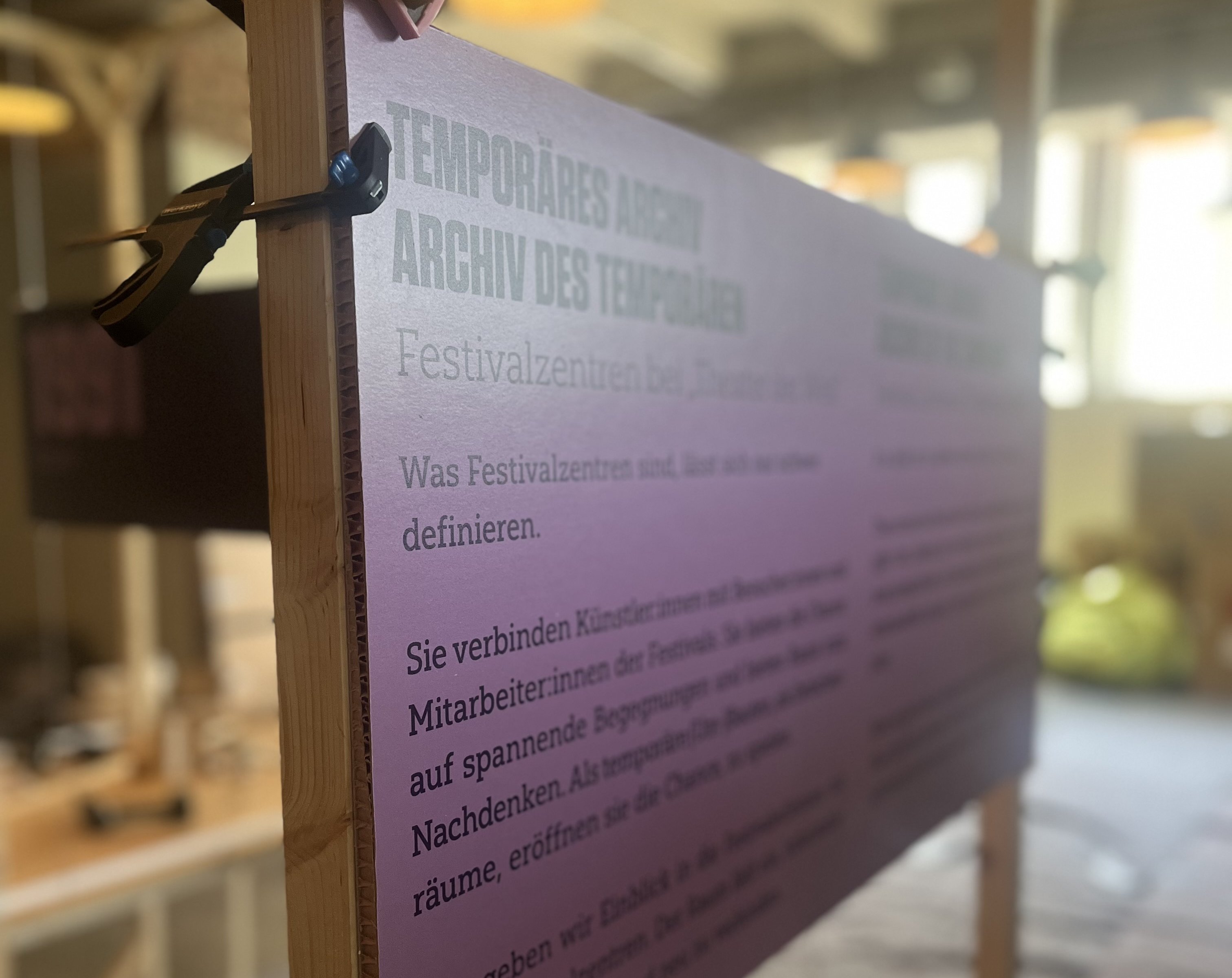
The exhibition by the International Theatre Institute Germany, ‘UM-AUF-AB-AUS-NEU. Archive und Festival THEATER DER WELT als temporäre Orte’ (UP-DOWN-OUT-NEW. Archive and Festival THEATER DER WELT as Temporary Spaces), which runs at THEATER DER WELT in Chemnitz from 19 June to 5 July, explores the significance of festival venues.
A long version of this text can be found here.
Footnotes
1 Nicola Scherer: Internationale Theaterfestivals, transcript Bielefeld 2020:37.
2 Marta Keil: Reclaiming the Obvious. On the Institution of the Festival; published by: Zbigniew Raszewski Theatre Institute; Konfrontacje Teatralne – Centre for Culture in Lublin; edited: Marta Keil, Warsaw 2018:15. This title refers to: Ivan Nagel: Theater heute 1981, opening speech at Theater der Welt 1981.
3 Nicola Scherer: Internationale Theaterfestivals, transcript Bielefeld 2020:37.
4 The International Theatre Institute (ITI) was founded in 1947 as a partner organisation of UNESCO in the field of the performing arts. Today, the ITI is represented in more than 90 countries through its national centres.
5 Information on the early years of the Theater der Nationen festival can be found in the International Theatre Institute / Martha W. Coigney Collection at the New York Public Library.
6 For information on the impact of the festival and the selection processes at TNF (Théâtre des Nations) during its time in Paris up to 1968, see Daniela Peslin: Le Théâtre des Nations. Une aventure théâtrale à redécouvrir. 2009, L’Harmattan.
7 For a discussion of the work of the international ITI and the impact of the TNF festival, see the ‘Journal of Global Theatre History’ (ISSN: 2509-6990), Vol. 4, No. 2, 2020, Viviana Iacob: ‘The University of the Theatre of Nations: Explorations into Cold War Exchanges’, p. 68.
8 Ivan Nagel: ‘Wie entstand Theater der Welt’; in: Theater der Welt. Arbeitsbuch II/99, ed. by Joachim Fiebach, on behalf of Theater der Zeit and the German Centre of the International Theatre Institute, Theater der Zeit, Berlin 1999. Insert, p.5.
9 Ibd., pp.4.
10 See, for example, Bettina Milz’s welcome message for the ‘favoriten 08’ festival; https://www.nrw-lfdk.de/files/fav08_progbuch_21fg.pdf
11 Theater der Welt. Arbeitsbuch II/99, ibid.; it is unclear to what extent subsequent festival curators are aware of this dogma.
12 And he wasn't alone with this thinking in Europe. (Elfert 2009:106) notes that this unconventional willingness to take risks – strengthening the independent theatre scene, presenting experimental theatre, developing different project timelines, and venturing into new formats – was only made possible by the more open forms of festival organisation compared to the municipal theatre scene in general.
13 Theater der Welt. Arbeitsbuch II/99, Ibid.: The restructuring involved equal funding from the federal government, the state and the city.
14 As Ivan Nagel stated in Theater Heute 08/89, p. 4. This also explains the unique situation in Hamburg in 1979: though not a capital city either, it was difficult to justify to political decision-makers as a permanent venue.
15 The regular three-year cycle was incorporated into the festival’s planning from 1993 onwards. Prior to that, the festival had been planned as a biennial event. Exceptions to this cycle were permitted for special projects (Ruhr 2010 – European Capital of Culture) or in the event of external factors (Covid-19 in 2020/21).
16 This title refers to an article by Kathrin Tiedemann in taz on 18 March 1996: “Bespielte Ruinen. Gewagt: Deutschlands größtes Theaterfestival in Dresden”.
17 The concept of porosity is used here in the sense of (Büscher/Krasny/Ortmann: ‘Porös-Werden’), drawing on its potential for the further development of urban spaces within the context of cultural institutions. (As the authors also mention, this concept traces its origins, amongst other things, to the idea of the porous in Walter Benjamin and Asja Lācis’s essay ‘Naples’.)
18 See also Jennifer Elfert (ibid.: p. 32), who discusses the link between festivals and international guest theatres as factors in the development of internationalisation.
19 Interview with Wolfram Kremer in the ‘Theater der Welt' archive, 2023.
20 On the development of the Muffatwerk as a cultural venue: https://www.muffatwerk.de/de/besucherservice/geschichte
21 Interview with Renate Klett in the ‚Theater der Welt‘ archive, 2018.
22 In January 1994, the architectural critic Wolfgang Pehnt wrote in the ‘Frankfurter Allgemeine Zeitung’ that there was little willingness on Dresden’s part to renovate Hellerau and that there were not even any heated rooms there.
23 The layers and intentions behind the ongoing restoration and renovation of the Hellerau Festspielhaus are described in detail in – Büscher/Eitel (eds.): ARBEITSHEFT #4. Produktionshäuser zeitgenössischer performativer Künste. HELLERAU – Europäisches Zentrum der Künste Dresden. Geschichte, Raumprogramm, kuratorische Konzeptionen und künstlerische Projekte, 2023.
24 Daniel Mufson: Performing spaces and history. Theater der Welt 96, available at: https://danielmufson.com/essays/performing-space-and-history-theater-der-welt-96/
25 Büscher/Eitel (eds.): ARBEITSHEFT #1. Produktionshäuser zeitgenössischer performativer Künste. Forum Freies Theater Düsseldorf. Geschichte, Raumprogramm, kuratorische Konzeptionen und künstlerische Projekte, p. 14.
26 Interview with Manfred Beilharz and Matthias Lilienthal, Deutsche Bühne 6/2002. Unfortunately, plans to develop such a venue in Cologne did not come to fruition in the context of the festival. It has not yet been realised.
27 See amongst others: Jahn Kahlcke: A monument to a modern feudal lord; in: taz, 25 November 2025.
28 Eitel: ibd., pp. 158-160.
29 E.g. Programme booklet ‘Theater der Nationen‘ 1979, p.130.
30 Programme booklet ‘Theater der Welt‘ 1996, p.37.
31 First defined in Ray Oldenburg’s bestseller: ‘The Great Good Place’, Berkshire, Massachusetts, 1989.
32 Festivals themselves were often conceived as a break in the theatre season and were thus already a form of exception to the regular theatre routine.
33 Jennifer Elfert: ibid, p.179.
34 Ibid., p.183.
35 See, among others, Joachim Fiebach: “Glokal – ein Theater der Darsteller-Körper” in ‚Theater der Zeit‘ 10/99, p. 21.
36 Programme booklet for Theater der Welt 2002, p. 53.
Footnotes
Christine Henniger is Project Manager of the Media Library for Dance and Theatre and coordinates the areas archive and practice as well as cultural heritage in the performing arts at the ITI. She previously worked at the HfS, the FU Berlin, the University of Hildesheim and at the Dachverband Tanz, after studying Philosophy and Linguistics at the HU Berlin. She was a DAAD scholarship holder in Uppsala and St. Petersburg.